


Before you hire almost anyone these days, you check the reviews. It’s sensible. It’s the modern version of asking a neighbour for a recommendation — except the neighbour is now a thousand strangers, and the conversation never ends.
But online reviews have become complex enough that reading them badly can leave you more confused than informed. The star rating at the top of a Google listing is both the most-checked number in modern consumer research and one of the most routinely misunderstood.
Here’s a proper guide to what online reviews actually tell you — and what they don’t.
Why Unhappy Customers Are Louder Than Happy Ones
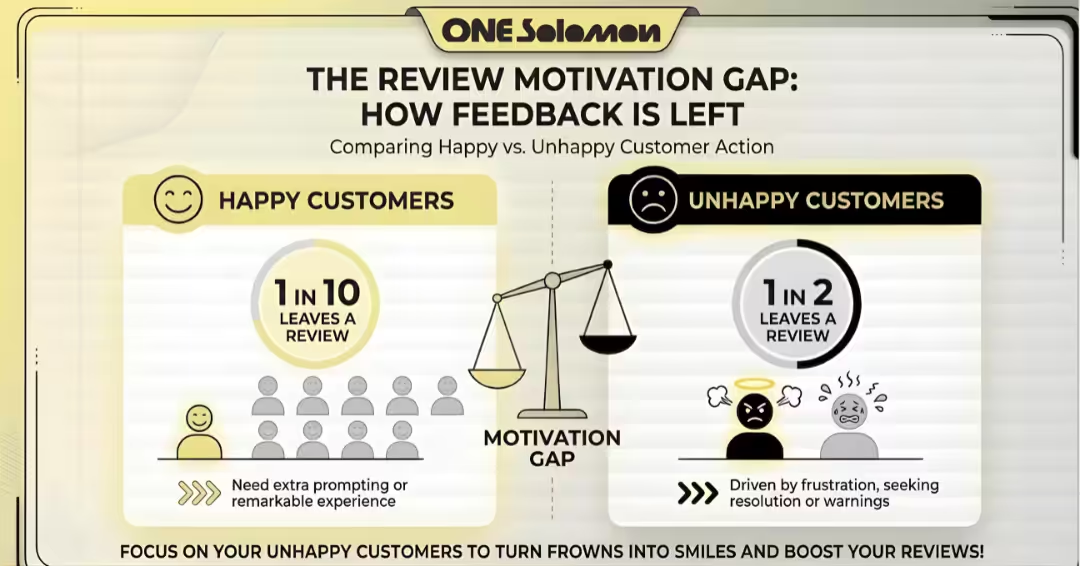 This isn’t cynicism. It’s behavioural science.
When something goes well, most people feel satisfied and move on. The blind looks great. The screen fits perfectly. The installer was professional and cleaned up after themselves. Excellent. Life continues.
When something goes wrong — even something minor — the emotional response is disproportionately stronger. Psychologists call this negati vity bias: humans are wired to register and respond to negative experiences with more intensity than equivalent positive ones. It’s an evolutionary holdover. Threats mattered more than pleasures.
In the context of reviews, this plays out clearly. A happy customer might mean to leave a review and never quite get around to it. A disappointed one is motivated to act almost immediately — they want to be heard, they want to warn others, and they want some form of acknowledgement or resolution. The energy behind a negative review is simply higher.
Research consistently shows that unhappy customers are anywhere from two to five times more likely to leave a review than satisfied ones.
What this means in practice: the negative reviews on any business’s profile are almost always over-represented relative to actual customer experience. The silent majority — the people who got exactly what they paid for and are quietly pleased about it — are largely invisible in the data.
Volume Isn’t Just Vanity. It’s Mathematics.
When a business has 12 five-star reviews and a 5.0 rating, that tells you almost nothing. It might be excellent. It might be the owner’s friends and family. You have no way to know.
When a business has 400 reviews and a 4.7 rating, you’re looking at something meaningful. At that scale, the rating reflects real, aggregated customer experience across hundreds of interactions. It’s statistically robust in a way that a handful of reviews can never be.
Here’s the counter-intuitive part: a very high review volume with a rating in the 4.5–4.8 range is often a stronger signal of quality than a perfect 5.0 from a business with fewer reviews. Why? Because at scale, some negative reviews are inevitable — and their presence, in reasonable proportion, is actually evidence of authenticity.
If a business has done thousands of jobs and has no negative reviews at all, one of two things is true: they haven’t been in business long enough, or someone is managing the reviews rather than earning them.
A genuinely high-performing company at volume will have some unhappy customers. Not because they’re poor at what they do — but because they serve enough people that occasional problems are a statistical certainty. A perfect record isn’t proof of perfection. It’s often proof of a small sample size.
The Ratio Is the Real Number
 Rather than fixating on the star rating, look at the ratio of positive to negative reviews.
Suppose a company has 350 positive reviews and 70 negative ones. That’s an 83% positive ratio — which sounds underwhelming until you consider the motivational asymmetry we just discussed. Given that unhappy customers are several times more likely to review than happy ones, an 83% positive ratio in the raw data likely reflects something closer to 95–97% genuine satisfaction in the actual customer base.
Now compare that to a company with 40 reviews and a 4.9 rating. On paper it looks better. In reality it tells you almost nothing about how the business performs at scale, under pressure, across hundreds of different jobs and customers with different expectations.
Volume-adjusted ratio thinking is how sophisticated buyers — particularly in trade and property — read reviews. The question isn’t ‘do they have any bad ones?’ The question is: ‘what does the overall pattern say, and how many real jobs is this based on?’
Even Apple and IKEA Have Poor Reviews
Consider two of the most beloved consumer brands in the world.
Apple consistently ranks among the highest customer satisfaction scores of any technology company. People queue overnight for their products. Brand loyalty is near-religious. And yet, if you look at Apple’s Google reviews for its retail locations, or search for iPhone reviews on any major platform, you will find thousands of one and two-star reviews. Complaints about customer service. Complaints about prices. Complaints about batteries, software updates, repair policies.
IKEA is one of the highest-trafficked retailers on earth. Millions of people genuinely love it. It also carries some of the lowest average review scores of any retail chain in Australia — because the sheer volume of customers it processes means that every possible failure mode, however rare, happens thousands of times.
This isn’t an argument that Apple and IKEA are bad businesses. It’s the opposite. It’s evidence that review profiles at scale tell a fundamentally different story than review profiles at small volume — and that a handful of negative reviews within a large base is not the red flag it might appear.
The brands with the most negative reviews online are often the brands serving the most customers. Volume and visibility are the price of doing significant business.
When you’re evaluating a local service business — a trade, an installer, a manufacturer — keep this in mind. A company with 20 years in business, thousands of completed jobs, and a review count in the hundreds is operating in a different mathematical universe to a company with 30 reviews and no negatives.
The Platforms Themselves Aren’t Neutral
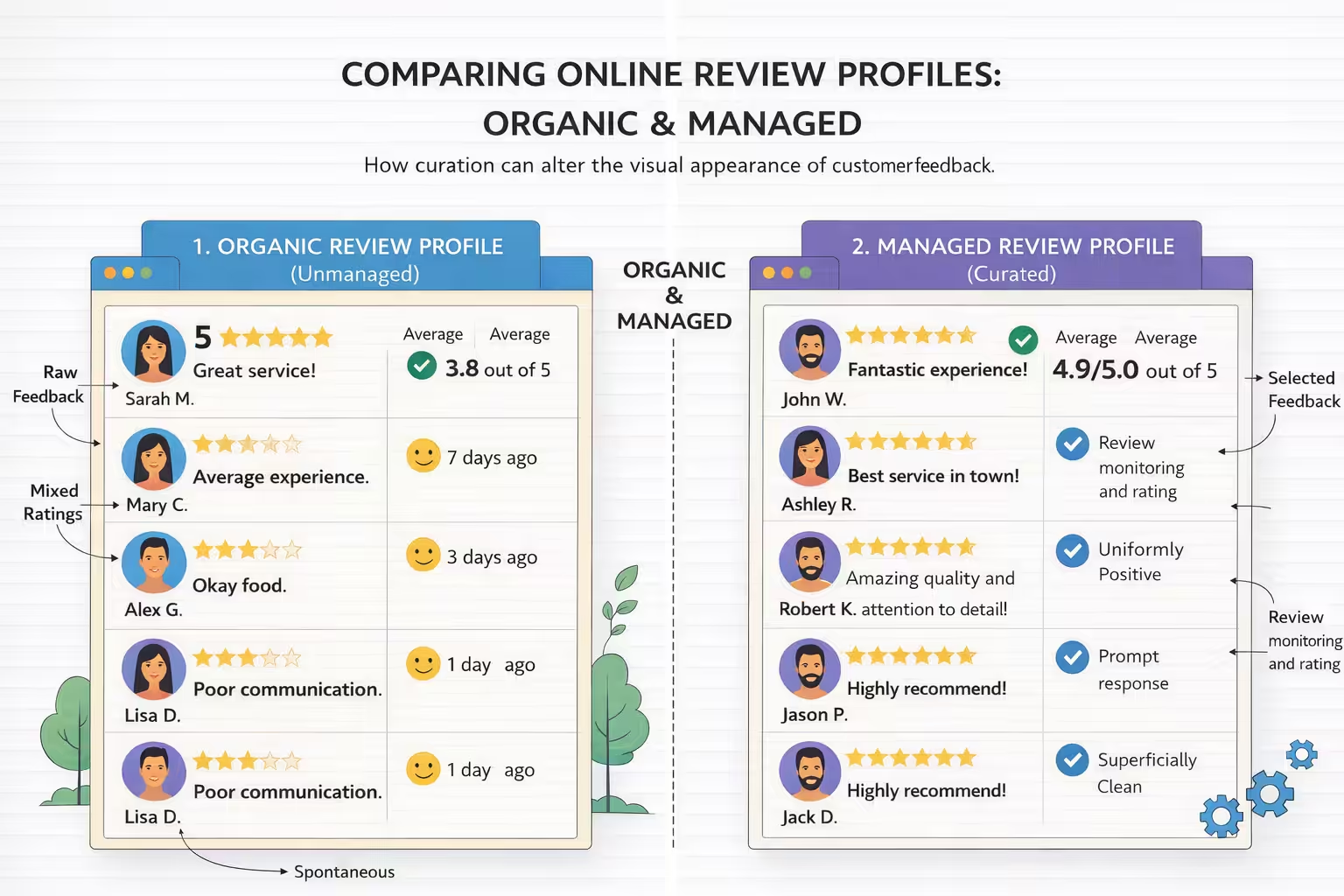
This is the part most people don’t think about — and it’s worth understanding.
Google, Yelp, Trustpilot, ProductReview and similar platforms are businesses. They generate revenue. And a meaningful portion of that revenue, in some cases, comes from the businesses being reviewed.
Most major review platforms offer paid business tools — profile management features, advertising placements, enhanced visibility, and in some cases, tools that allow businesses to request the removal or suppression of certain reviews, or to push positive reviews higher. The terms vary by platform and change frequently, but the commercial dynamic is consistent: businesses that pay the platform have more tools available to manage how their profile appears.
This doesn’t mean every review platform is corrupt or every rating is manipulated. Most aren’t. But it does mean that a suspiciously clean profile on certain platforms — particularly where the business is a paying advertiser — deserves a second look.
Google reviews are generally considered the most reliable primary source, because they’re tied to verified Google accounts, harder to game at scale, and Google’s review ecosystem is large enough that outlier manipulation tends to be visible. Even there, review bombing (coordinated negative campaigns, sometimes by competitors) and incentivised positive reviews are real phenomena worth being aware of.
What to Actually Look For
So if the star rating is a blunt instrument, volume matters more than perfection, and the platforms have their own interests — what should you actually look at when researching a service company?
Recency and consistency.
A business with strong reviews over several years, including recent ones, is demonstrating sustained performance. A business that had great reviews two years ago and nothing since warrants a question.
The content of the positives.
Generic five-star reviews that say ‘great service!’ tell you less than specific ones that describe the job, the product, the installer, or the process. Specificity in positive reviews is a signal of authenticity. ‘The team measured twice, the shutters fit perfectly first time, and the installer took his shoes off at the door’ is more useful data than ‘highly recommend!’
How they respond to negatives.
This is arguably the most revealing signal in a review profile. A business that responds to negative reviews with empathy, specificity, and a genuine attempt to address the issue is demonstrating a culture. A business that responds defensively, dismissively, or not at all is also demonstrating a culture. Either way, you’re learning something real.
The pattern within the negatives.
One review complaining about communication. One complaining about a delay. One about a product that needed adjustment. These are isolated incidents across a large job count — they happen everywhere. But if multiple negative reviews mention the same installer, the same product type, or the same failure point, that’s a pattern worth noting.
What to Largely Ignore
- Single one-star reviews with no detail. ‘Terrible service’ with nothing else is unverifiable and often illegitimate.
- Reviews that are suspiciously similar in language, timing, or structure — these can indicate coordinated activity in either direction.
- Reviews about price. ‘Too expensive’ is a statement about the reviewer’s expectations, not the company’s quality.
- Reviews about outcomes the company couldn’t control — weather delays, product lead times from manufacturers, council approvals. Complaints about things outside a company’s control are noise, not signal.
- Anything on a platform that financially benefits from reviews being visible or hidden.
For What It’s Worth — Ours.
We’ve been in business since 1987. We’ve installed products in thousands of Brisbane and South East Queensland homes. We have a lot of reviews — positive ones, and some negative ones too.
We’re not going to pretend every job has gone perfectly. Some haven’t. What we can tell you is that when something has gone wrong, we’ve owned it and fixed it — and if you look at how we’ve responded to critical feedback in our review profiles, you’ll see that in practice.
What we’re proud of is the ratio. At our scale, a positive-to-negative ratio that consistently outperforms national brands and major retailers is not an accident. It’s the result of the same thing that’s driven this business for nearly four decades: doing the job properly, the first time, every time.
Measured twice.