


Security door marketing has a word it loves more than any other: strength. Doors that can withstand thousands of joules. Mesh that’s twice as strong as the competition. Products that ‘surpass Australian Standards’ by extraordinary margins.
It sounds reassuring. It’s also largely beside the point.
Because the question you should be asking when you invest in a security screen isn’t ‘how hard can this door be hit?’ It’s ‘how does a real intruder actually get through a door — and does this product stop that?’ Those are different questions. And the security industry, to its discredit, often answers the first one while hoping you don’t think about the second.
What the Australian Standard Actually Tests
Security screens in Australia are assessed under AS 5039 — the standard that defines what a product needs to do before it can legitimately call itself a security screen. To pass, a product must be tested under six separate tests, each simulating a different method of attack.
| Test Name | What It Simulates | Real-World Equivalent |
|---|---|---|
| Dynamic Impact | A 40 kg weighted bag strikes the door five times at 100 joules | Body-weight blow or kick |
| Knife Shear | A heavy knife cuts across the mesh under load | Cutting with a utility knife or box cutter |
| Pull Test | The mesh is mechanically pulled from the frame | Hands or tool gripping and tearing mesh |
| Jemmy Test | A screwdriver or crowbar levers corners and lock points | Prying with a crowbar |
| Probe Test | Metal probes check for gaps near locks and hinges | Accessing the lock mechanism through a gap |
| Shear Test | Cutting and twisting at frame corner joints | Attacking the structural junctions of the frame |
Passing all six is the minimum requirement for certification. Failing any single one means the product is not compliant — regardless of how well it performs on the others.
That last point matters more than it might seem. A product can be extraordinarily resistant to impact and still fail the knife shear test, or the jemmy test, or the pull test. All six gaps need to be closed. A product that excels at one and is average at the others is not a more secure product than one that performs consistently across all six.
The Impact Obsession — and Why It Misleads
Pick up almost any security screen brochure and you’ll find some version of the same claim: an impressive joule number, often running into the thousands, presented as evidence of superior security.
Here’s what that number actually represents. The Dynamic Impact Test requires a door to survive five strikes from a 40 kg sandbag at 100 joules each. That’s the standard. Products that go beyond the standard — surviving 1,000 joules, 2,000 joules — are demonstrating extra performance in that one specific test. They are not demonstrating better overall security.
Passing the impact test harder doesn’t make a door twice as secure. It means it endured more lab hits — in a single category that accounts for a small fraction of real-world forced entries.
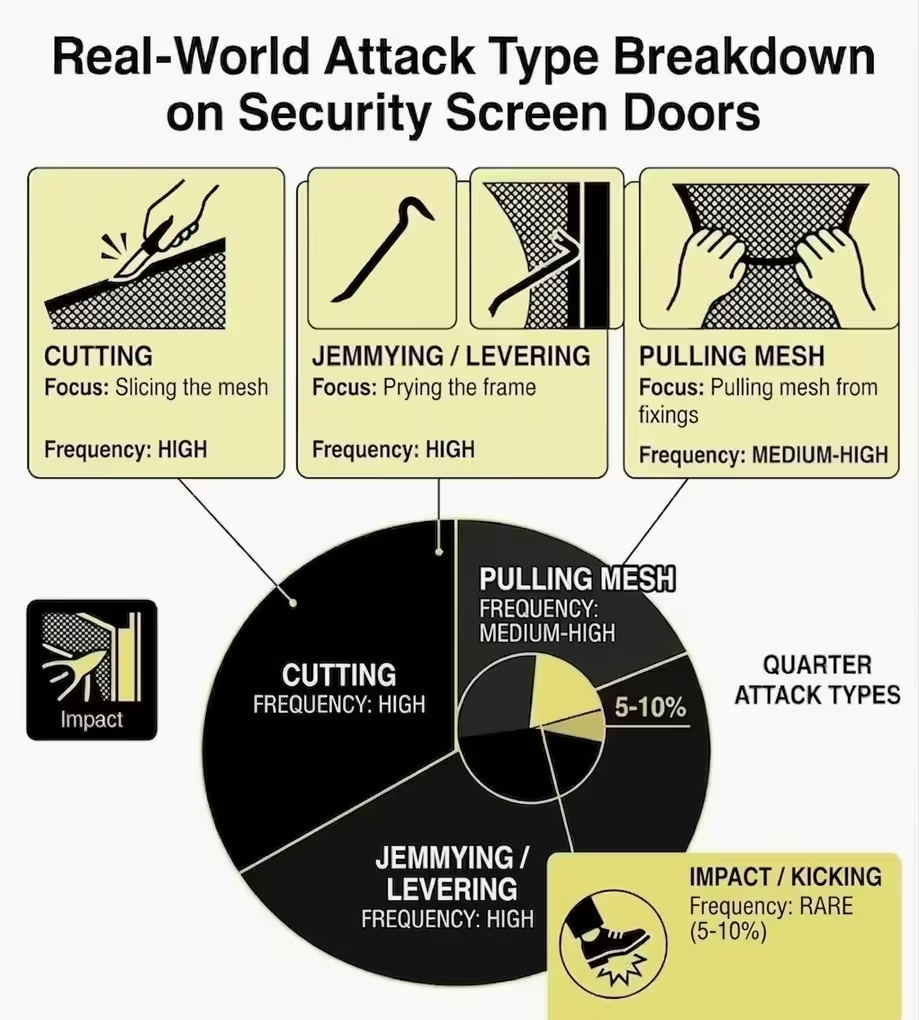
Impact, in terms of actual break-in attempts, is the least common attack method. Most forced entries involve jemmying — prying at the frame around lock points and corners — or cutting, or pulling the mesh away from its fixings. These are quieter, faster, and less conspicuous than shoulder-charging a door. They’re also precisely the attacks that joule-count marketing doesn’t address.
How Homes Are Actually Broken Into
Leverage and cutting account for the overwhelming majority of forced entries through doors and screens. An intruder with a screwdriver working at the corner of a door frame, or a utility knife drawn across mesh fabric, is doing so quickly, quietly, and with tools available in any hardware store.
A door that can absorb a 2,000-joule impact but whose mesh can be cut in four strokes of a knife, or whose fixing system gives way under a crowbar, is not a secure door. It has passed one test and potentially failed the others that matter more in practice.
The Dynamic Impact Test has its place — it confirms the product has structural integrity and won’t fail catastrophically under force. But framing it as the headline measure of a door’s security capability is like judging a car’s safety record purely on its ability to survive a head-on crash, while ignoring its braking performance, its tyres, and its side impact rating.
‘Exceeds Australian Standards’ — What That Phrase Really Means
Security screen marketing is full of phrases designed to sound conclusive: ‘surpasses Australian Standards,’ ‘exceeds requirements by 2,000%,’ ‘tested beyond compliance thresholds.’ These phrases have become so common that consumers reasonably treat them as a mark of quality.
They’re not. Or rather, they’re meaningless unless you know three things: which specific test they’re referring to, how the testing was conducted, and who certified the result.
Which test?
A product that ‘exceeds Australian Standards’ in one test category while barely passing — or not disclosing results for — the other five is not a superior product. It has performed well in one dimension of a six-dimensional assessment.
In-house testing vs. NATA-accredited testing.
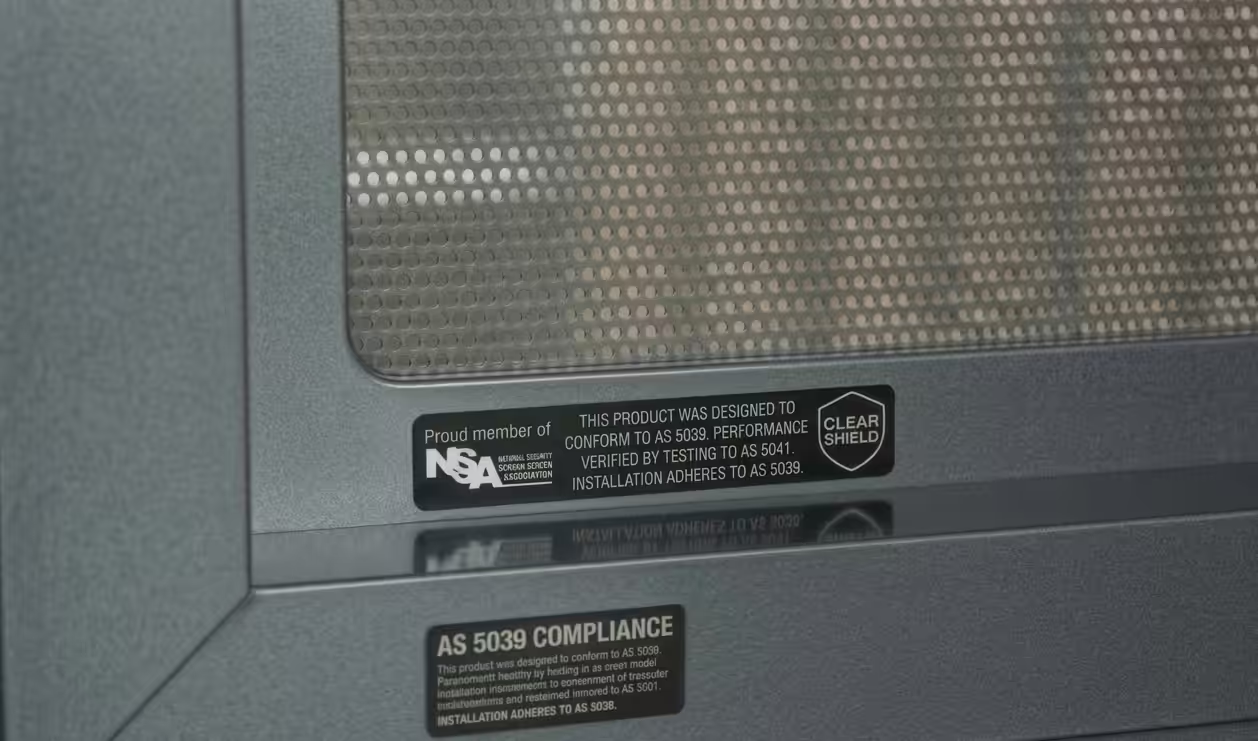
Genuine compliance requires testing by a NATA-accredited laboratory — an independent facility operating under standardised conditions with calibrated equipment. NATA accreditation ensures the test was conducted properly and its results are verifiable.
Terms like ‘in-house tested,’ ‘independently verified by our own engineers,’ or simply the absence of any NATA reference number are red flags. They typically mean the testing was self-administered, cannot be independently reviewed, and should not be treated as equivalent to certified compliance.
Certification numbers.
A genuinely compliant AS 5039 product carries a certification number that can be referenced and verified. If a supplier quotes joule figures but doesn’t quote a certification number, the reasonable question is: was it certified at all?
‘Exceeds Australian Standards’ is a marketing phrase, not a compliance statement. Ask which test, who certified it, and what the certification number is.
What the Australian Standard Doesn’t Cover
Even a product that genuinely passes all six tests under AS 5039 has only met the minimum benchmark. The standard certifies that the product performed adequately in a laboratory. It doesn’t certify how it will perform on your home after five years in a coastal Queensland environment. For that, you need to look at factors the standard doesn’t address.
Corrosion and galvanic isolation.
Most security screens involve dissimilar metals in contact — typically stainless steel mesh in an aluminium frame. Where these metals meet in the presence of moisture, galvanic corrosion occurs: an electrochemical reaction that progressively degrades the metals at the junction. In a coastal or high-humidity environment, this is not a theoretical concern. It is a predictable outcome if the assembly doesn’t account for it.
Good design isolates the metals from each other using non-conductive materials. Poor design — including, in some cases, the use of steel fasteners through aluminium frames and stainless mesh — creates exactly the galvanic pathway it should prevent. The lab test won’t catch this. But your environment will, over time.
The fixing system — where mesh retention actually lives.
The most critical structural question about any security screen is how the mesh is held in the frame. Under a jemmy attack or a pull attack — the real-world scenarios — the fixing system is what determines whether the mesh stays in place or separates from the frame.
Fixing systems vary considerably. Screws through the mesh and frame create direct metal-to-metal contact points that can corrode and loosen over time. Wedge and compression systems hold mesh by pressure, which depends on consistent tolerances. Crimped-edge designs — where the mesh edge is mechanically folded into the frame profile — eliminate the need for penetrating fasteners altogether, distributing retention force across the entire perimeter rather than concentrating it at specific points.
The fixing system is rarely the headline item in a security screen brochure. It should be one of the first questions you ask.
Mesh type — woven wire vs. perforated sheet.
The two main materials used in premium security screens — woven stainless wire mesh and perforated stainless steel sheet — have meaningfully different performance profiles in daily use, not just in security testing.
Woven mesh is constructed from interlocked wire strands. It offers excellent strength when the weave is intact, but the joins between strands accumulate dust, grime, and in coastal environments, salt. This buildup reduces visibility and airflow over time, and in high-exposure locations can become a corrosion vector if cleaning schedules aren’t maintained.
Perforated sheet — a single continuous piece of stainless steel with punched holes — has a flat, smooth surface. There are no joins to trap debris. Cleaning is straightforward. In terms of rigidity, a single sheet has inherently less flex than woven construction, which in larger doors reduces or eliminates the need for a midrail. For visibility, light, and airflow, the consistent open area of perforated sheet typically outperforms woven mesh at comparable hole sizes.

The midrail question.
A midrail is a horizontal bar running across the middle of a security screen door. Some products require one to achieve their rated performance. This matters because a midrail isn’t simply an aesthetic choice — it’s a structural necessity for products whose mesh or frame lacks sufficient rigidity to span a full door height without it.
If a product needs a midrail to meet its test results, then the door without a midrail is not performing to the same specification. It’s worth asking: does this product require a midrail to pass testing — and if so, what does it do without one?
Installation quality.
A door that passes every test in a laboratory is only as good as its installation. The standard AS 5040 governs installation requirements — fixing into structural elements rather than just the reveal, using appropriate fasteners, ensuring the door is square and correctly aligned. Poor installation can defeat a product’s tested performance entirely.
This is a reason why the installer’s competence and accountability matters as much as the product specification. A product certified to AS 5039 and installed to AS 5040 by an experienced team is a genuinely different outcome from the same product bolted in by whoever was cheapest.
One More Thing: ‘Security Door’ vs. Barrier Door
Not every door sold as a ‘security door’ is one. The term is used loosely in the market, and a meaningful proportion of products that look like security doors — mesh, frame, latching hardware — have not been tested to AS 5039 and cannot legitimately claim compliance.
A barrier door — which is what many products in this category actually are — is designed to provide ventilation, keep insects out, and create a visible deterrent. It is not engineered or tested to resist forced entry. It will deter an opportunist who doesn’t try very hard. It will not stop a determined attempt.
The distinction is real and consequential. A certified security door must pass the six tests. A barrier door hasn’t been subjected to them. If you’re investing in a screen for security purposes, the first question to ask is: is this product certified to AS 5039, with a verifiable NATA test report?
The Questions Worth Asking
When you’re comparing security screen products and suppliers, here is what actually matters:
- Is this product certified to AS 5039? What is the certification number?
- Was testing conducted by a NATA-accredited laboratory? Can I see the test report?
- Does the product pass all six tests — not just impact? What are the results for knife shear, jemmy, and pull?
- What is the fixing system, and how does it retain the mesh under jemmy and pull attack?
- Does this product require a midrail to meet its tested specification?
- How does the assembly address galvanic corrosion between dissimilar metals?
- Is the installer qualified and accountable? Is the installation warranted separately from the product?
These are not trick questions. A supplier who can answer them clearly and specifically is one worth listening to. A supplier who deflects to joule counts and ‘exceeds standards’ language is telling you something too.
What We Think About ‘Strength’
At ONESOLOMON, we’ve been manufacturing and installing security screens in South East Queensland since 1987. We’ve watched the marketing language in this industry get increasingly hyperbolic — and increasingly detached from what actually protects a home.
The products we specify and install — including the Clearshield® perforated stainless steel system — are certified to AS 5039, tested by a NATA-accredited laboratory, and engineered to address every one of the real-world failure points described in this article: corrosion isolation, fixing retention, mesh rigidity, installation standards.
We’re not interested in headline joule numbers. We’re interested in what happens when someone actually tries to get through the door — with a screwdriver, a knife, or their bare hands. That’s the test that matters. And it’s the one we build to.